
The Baptist Church of Rutland organized the construction of the North Clarendon Chapel in 1871. The chapel, also known as Chapel 1871, was built on Crown Point Road, a historic road completed in 1759 that roughly followed an old Native American trail.
The Town of Clarendon at that time had a larger population than Rutland but much of the town’s early history has disappeared. The town had many districts and each one had a school. The 1869 map of Clarendon indicated there were 9 schools at that time, 1 for each district. That time frame corresponds nicely with the construction of the North Clarendon Chapel. Other historic building from this time include the Brick Church (1824), the Queen Anne East Clarendon Chapel and the Chippenhook Meetinghouse (built in 1798 and burned down in 1971.) The town has very few buildings remaining from that period. The Chapel was at the old core of North Clarendon Village where one would have found a tavern, a tea house and an inn.
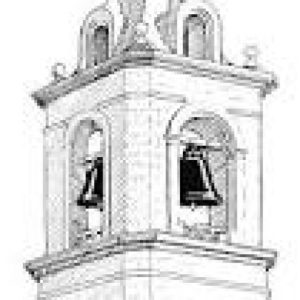
The building is significant for its vernacular style and is a major landmark in the village of North Clarendon. The chapel displays rounded colored glass windows, a steeple and an open shingled belfry with a polygonal spire.
Significant Characteristics
- Steeple

The open shingled belfry has a polygonal spire and its original bell.
- Roof
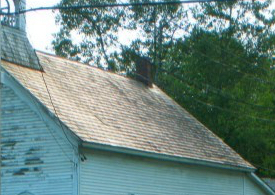
Purple slate quarried in Vermont. It is a rare stone used for interior and exterior applications. Purple slate has superior properties and performance. It is uncommon and the unique plum color and rich texture makes it very desirable.
- Windows
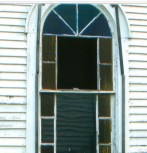
On the south side of the chapel, there are 6/6 wood double-hung window, and 9/11 Queen Anne wood double-hung windows with colored glass.
- Tin Ceiling Design

A classic tin ceiling design was primarily comprised of various pieces: tin ceiling tiles, moldings, fillers and cornices. Tin ceilings were installed in a variety of intricate patterns which made each ceiling unique, as the possible combinations and finishes when painted were literally endless. Some applications varied from minimal installations, which served as decorative focal points and were installed as small accent pieces in the room, while others would be much more elaborate. Tin ceilings were manufactured in tin plate, and other metal sheets such as copper, steel, aluminum or stainless steel panels. The metal was then stamped with complex and sophisticated patterns, copied and developed from which originally, could easily be shipped across North America the finest carved and molded plasterwork.
 Chapel 1871